
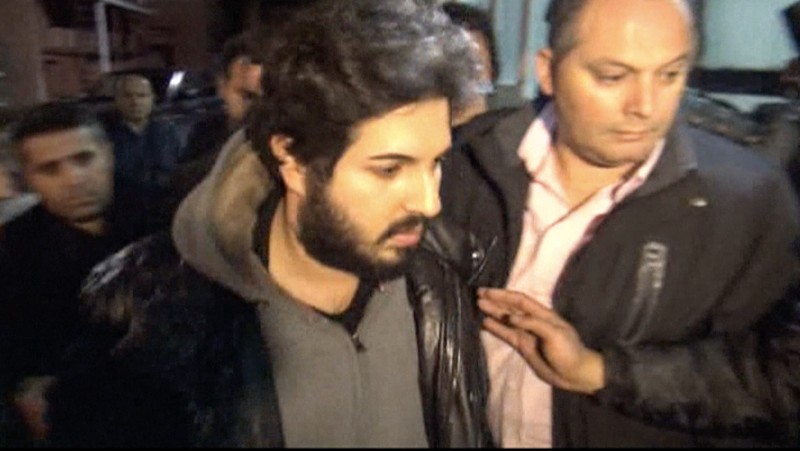
A federal judge in New York on Tuesday allowed notorious money launderer Reza Zarrab to escape a federal jail term, more than eight years after the wealthy financier pleaded guilty to helping Iran evade U.S. sanctions.
Zarrab’s defense team, in a sentencing memorandum to the court, urged U.S. District Judge Richard M. Berman to set Zarrab free. They noted that since pleading guilty in 2017 he has helped prosecutors as a witness in the prosecution of Turkiye Halk Bankasi, A.S., a Turkish lender known as Halkbank.
The judge agreed, and waived any forfeiture because defense lawyers argued that Zarrab’s net worth was more than negative $50 million. Prosecutors had asked for a downward departure in sentencing, not giving a specific number but signaling they were not opposed to time served.
Dressed in a conservative suit, a somber Zarrab thanked the judge and said he appreciated the U.S. government and law enforcement officials for his safety and protection.
The case strained U.S.-Turkish relations. Zarrab’s cooperation, the sentencing memorandum said, cost him “his family, his name, his country, hundreds of millions of dollars of his assets, and hundreds of millions of dollars of his extended family's assets, and… nearly cost him his life.”
Indicted in 2015 and arrested by the FBI in 2016, Reza Zarrab pleaded guilty in 2017 to conspiring to evade U.S. sanctions. He subsequently testified against Mehmet Hakan Atilla, an executive at the state-owned Halkbank, during a federal trial in New York. Atilla was ultimately convicted of helping Iran bypass U.S. financial sanctions.
In 2019, Halkbank was charged by the U.S. in a “six-count indictment with fraud, money laundering, and sanctions offenses related to the bank’s participation in a multibillion-dollar scheme to evade U.S. sanctions on Iran.”
But in a sudden move last month, the Trump administration announced it had agreed to entirely drop money laundering and sanctions charges against Halkbank. The parties agreed to a deferred prosecution agreement that required Halkbank to cooperate with U.S. prosecutors if asked to make a case against Reza Zarrab.
Zarrab’s defense team argued that the cooperation clause in the Halkbank settlement “could further jeopardize Reza's liberty, safety, and financial interests.” They alleged he is under threat by Iran and Turkey and faces a “substantial seizure of his and his family's assets that already has occurred in Turkey by the government there as a direct response to his truthful cooperation.”
The defense team’s memorandum pointed the judge to recommendations from the Probation Office, which declared that Zarrab has fully accepted responsibility and has already been financially ruined by his cooperation.
Reza Zarrab’s family assets in Turkey were seized in retaliation for his testimony, the filing said, and his current net worth has plummeted to negative $51 million, adding that he had already forfeited a $288,000 boat and more than $88,000 in cash to the U.S. government.
In their sentencing memorandum, prosecutors credited Zarrab’s assistance.
“While the charges against Atilla and other co-defendants were filed based solely on evidence entirely independent of Zarrab’s testimony and cooperation, Zarrab’s first-hand account of the design and execution of the complex, multi-year money-laundering system was helpful to the jury, corroborated by a wealth of evidence, and fully truthful and credible,” prosecutors noted. “Zarrab also paid a high price for his honesty: he suffered significant threats and retaliation because of his cooperation.”
Zarrab was born in Iran but moved to Turkey as a child and later worked in his family’s currency-exchange business in Dubai. Prosecutors detailed how he helped launder Iranian oil sales through deposits in Turkey that were used to buy gold and export it to Dubai, where it was sold and the money returned to Turkish accounts tied to Iran.
The prosecutors’ memorandum noted that while in detention in New York, Zarrab was caught bribing a guard to acquire an illegal cellphone and alcohol. He was moved out of detention in New York to FBI custody after an inmate at the Metropolitan Detention Center confided he had been contracted to kill Zarrab before he cooperated.
In 2021, an investigation by OCCRP, Law&Crime, and the Miami Herald found that Zarrab remained connected to his former criminal network and had received multiple questionable wire transfers from Turkey. Using fake identities, he had invested in thoroughbred horses and a palatial equestrian facility in South Florida, entering an industry rife with fraud and money laundering.
The prior year, Zarrab was featured in the FinCEN Files, a global collaboration based on a leak of Suspicious Activity Reports from banks. Some of these documents implied that Zarrab had delivered a bribe to the Iranian president and helped Iran skirt U.S. financial sanctions by laundering the money from Chinese buyers of Iranian oil.
Note: Adam Klasfeld of All Rise News contributed from New York
Source: Original article