

Russia’s Federal Security Service (FSB) had been developing an artificial intelligence system designed to merge public media monitoring with restricted databases to help officers search for information about people and events, according to an investigation by OCCRP partner IStories.
The project was never delivered, but leaked documents show how the FSB planned to use Artificial Intelligence technology developed by U.S. companies in its intelligence gathering operations.
The documents indicate that a little-known technology company in Kazan called Micord worked on the system, named PAUK (spider) — a Russian acronym for “Portal for Analytics and Usage of Contents.” The internal documents were obtained after hackers breached Micord’s infrastructure in December 2025 and passed the material to the rights group Idite Lesom, which shared it with IStories.
The same leak was used in earlier IStories investigations into Russia’s digital military registry and other classified Defense Ministry systems.
Documents reviewed by IStories indicate that PAUK was being built for the FSB’s Second Service, the unit responsible for protecting the constitutional order and combating terrorism. Previous investigations have linked the unit to the surveillance of opposition figures, activists and protest movements in Russia.
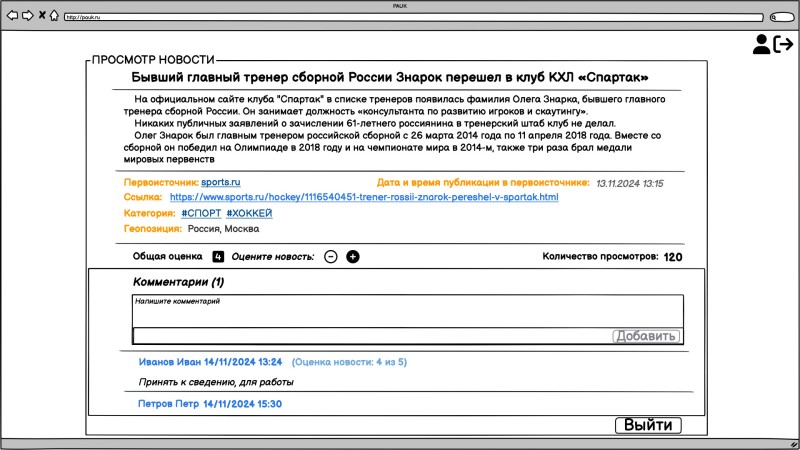
PAUK was meant to automate a situation center where officers monitor Russian and foreign media and prepare daily briefings for FSB leaders. A web crawler would gather reports from selected websites and Telegram channels, while officers could edit, rate and categorize the material before adding it to internal briefings.
The closed part of the system would store approved media reports alongside “other materials from closed sources,” including scans, and internal summaries. Officers could search the material through a chatbot powered by a large language model.
Project documents show that the chatbot’s responses could include a person’s full name, date of birth, region, phone number, license plate and vehicle model. An FSB official overseeing the project wrote that PAUK would initially have 30 users, potentially rising to 400.
Micord received FSB news briefings compiled between January 2024 and June 2025 to train and test the system. IStories analyzed nearly 5,000 items, many of which covered Islamist activity, opposition movements, political violence, migration, protests abroad and ethnic tensions in Europe.
Independent Russian outlets featured prominently. More than 550 of their reports appeared in the briefings — over 10 percent of the material collected by the FSB in the same timeframe. Activatica, which covers civic activism and state repression, provided one in every six items in the first half of 2025. One briefing included reports on a utility-rate protest in Ufa, a campaign against a packaging plant in Moscow, and demonstrations over relocating an ambulance station in the Arkhangelsk region.
Micord planned to use several foreign technologies, including Meta’s LLaMAa 2 model, the U.S.-developed LlamaIndex framework, and MongoDB. The company stopped work on PAUK in the fall of 2025, according to its internal task tracker. “Goodbye, project,” one employee wrote.
Source: Original article