
The European Union included a Georgian oil refinery that processes Russian crude into its new sweeping sanctions package aimed at crippling Moscow’s war economy.
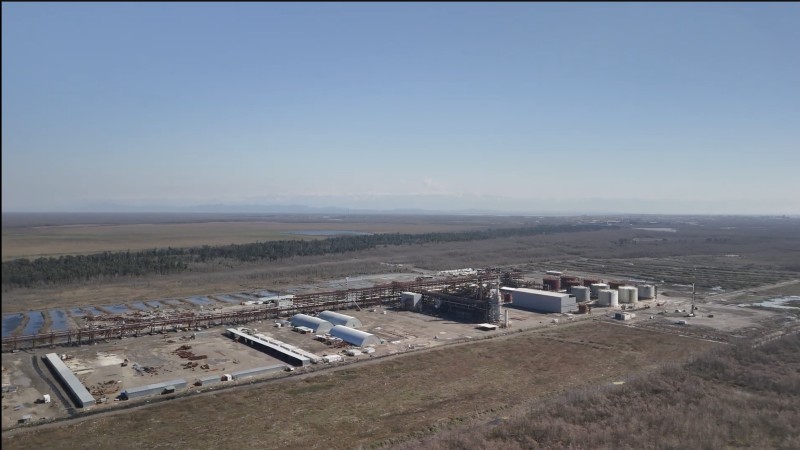
The Council of the European Union adopted the restrictive measures—the 21st package—on Thursday, establishing a mechanism to prohibit transactions with refineries in third countries that help generate revenue for Russia. Under this framework, the EU is imposing a transaction ban on the Kulevi refinery that will enter into force in six months.
RFE/RL, citing a source in Brussels, reported that the EU's Official Journal lists January 25, 2027, as the date the ban takes effect. A separate source told the outlet that the six-month deferred mechanism is the first of its kind in the EU's sanctions practice.
“With each round of sanctions, we squeeze Russia’s economy and its capacity to prolong its illegal war,” Kaja Kallas, the EU’s High Representative for Foreign Affairs and Security Policy, said in the Council’s statement.
The Kulevi refinery is operated by Black Sea Petroleum, a company controlled by Georgian businesswoman Maka Asatiani. It operates as a separate legal entity from the neighboring Kulevi oil terminal, which is owned by Azerbaijan's state oil company, SOCAR.
Vakhtang Chakhnashvili, a member of Black Sea Petroleum's supervisory board, pushed back against the EU’s framing, telling local broadcaster TV Pirveli that the restriction is a “preventive measure” applied to refineries broadly, rather than a direct sanction. He said the company had already signed contracts to shift to non-Russian crude by late August or early September. If Brussels had actual evidence of sanctioned oil entering the facility, Chakhnashvili argued, it would have imposed immediate penalties rather than a six-month delay.
The facility first entered EU deliberations at the start of the year. In February 2026, OCCRP and RFE/RL reported on a European Commission proposal to include the Kulevi terminal in the EU’s 20th sanctions package, alongside facilities in Russia and Indonesia. EU member states ultimately did not adopt that proposal. In March 2026, EU Sanctions Envoy, David O'Sullivan, informed Georgia's foreign minister that the terminal would be excluded, citing commitments made by Georgian authorities and SOCAR.
However, Georgia's President, Salome Zourabichvili, recently warned in a statement that Georgian assets were being used to help finance Russia's war, accusing the country’s leadership of undermining its sovereignty by permitting sanctions evasion.
OCCRP's Georgian partner, iFact, has published a series of investigations into Kulevi port and refinery over the past several months detailing the flow of Russian oil. In June, iFact revealed that the tanker Nephira brought approximately 30,000 tons of Russian oil products to the port. Earlier, in January, the outlet reported that the sanctioned tanker Silvar unloaded up to 24,000 tons of oil or oil products at the facility.
Beyond the Kulevi refinery, the 21st package includes the highest number of individual listings in four years. The EU added 218 individuals and entities to its sanctions list, including more than 50 linked to the Russian military-industrial complex.
The measure also froze assets tied to 94 Russian banks and major financial institutions, listed 41 additional vessels linked to Russia’s shadow fleet, and extended a transaction ban to 14 crypto-related service platforms based in countries including Georgia, Panama, the UAE, the Marshall Islands, Kyrgyzstan, and Belarus.
Source: Original article