
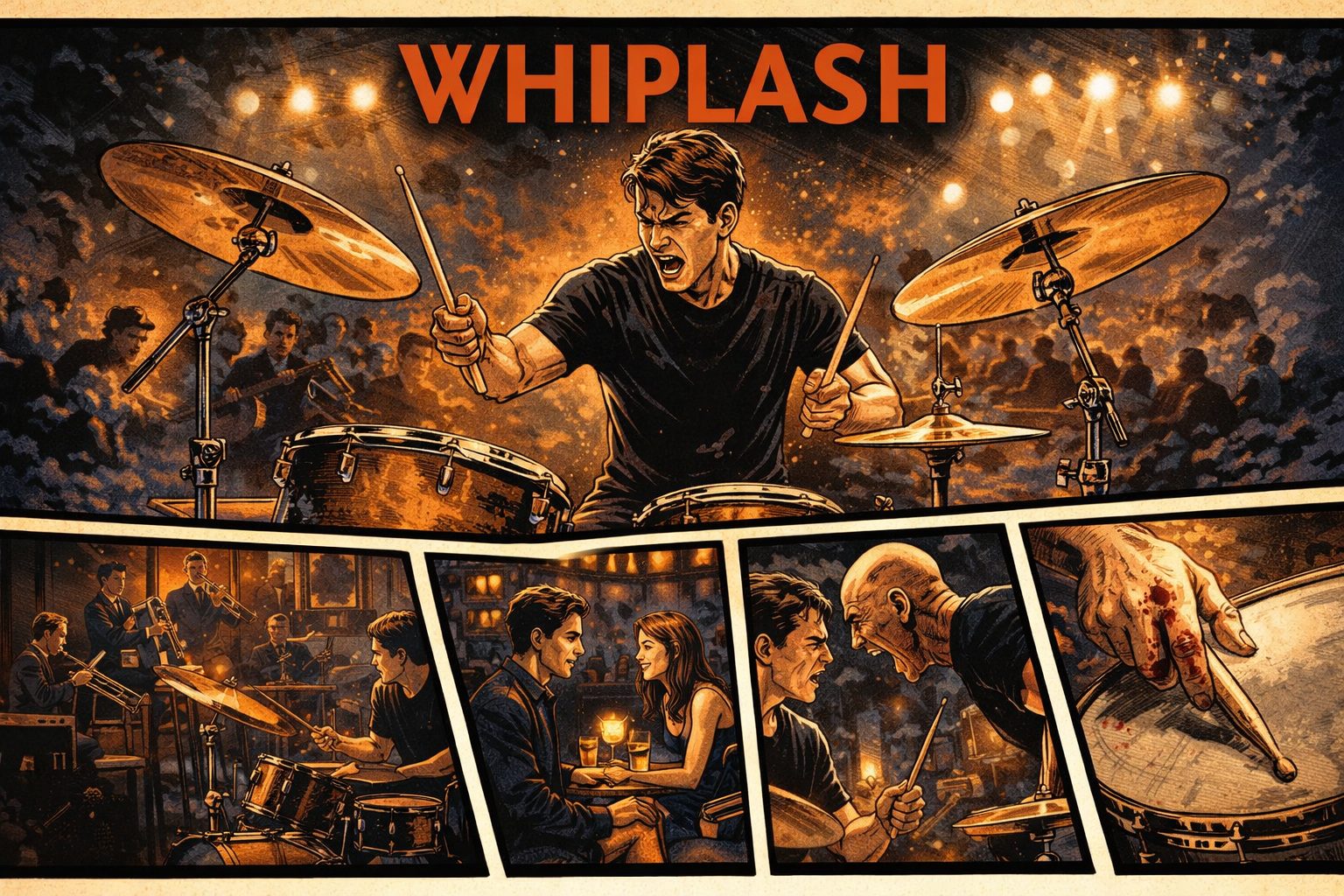

Few modern films are as intense, concentrated, and unsettling as Whiplash. Directed by Damien Chazelle and released in 2014, the film appears at first to be a drama about music education, discipline, and artistic ambition. But very quickly, it reveals itself as something harsher and more dangerous. Beneath the story of rehearsals, competition, and performance lies a deeper question: how much damage is a person expected to endure in the pursuit of greatness, and at what point does ambition become a form of self-destruction?
A battle disguised as mentorship
At the center of the film is Andrew Neiman, played by Miles Teller, a young jazz drummer who wants not simply to be good, but to become extraordinary. He is ambitious, isolated, and willing to submit himself to extreme pressure if it brings him closer to excellence. His world changes when he comes under the control of Terence Fletcher, played by J.K. Simmons, a teacher whose methods are built on humiliation, fear, and psychological domination.
What makes Whiplash so gripping is that the relationship between Andrew and Fletcher is never presented in simple terms. Fletcher is abusive, manipulative, and often cruel, yet he also understands how strongly ambition can distort a person’s moral boundaries. Andrew, meanwhile, is not merely an innocent victim. He chooses, again and again, to remain inside that destructive system because he believes suffering may be the price of greatness. This turns the film into more than a story about an abusive teacher. It becomes a story about complicity, hunger, and the dangerous seduction of achievement.
More than a film about music
One of the reasons Whiplash has remained so powerful is that it does not require the audience to care deeply about jazz in order to work. The film is not really about musical style in a narrow sense. It is about performance as conflict. Every rehearsal feels like a duel. Every correction feels like an attack. Every act of playing becomes a test not only of technique, but of identity and endurance.
Chazelle directs these scenes with the energy of a thriller. The cuts are sharp, the rhythm is relentless, and the physicality of performance is impossible to ignore. Sweat, blood, breath, and sound are all given equal importance. Drumming in the film does not appear elegant or refined. It looks exhausting, painful, and nearly violent. That choice gives Whiplash its unusual force. It strips artistic excellence of its romantic image and shows the body underneath the dream.
Two performances locked in combat
Miles Teller gives Andrew a fragile intensity that keeps the character from becoming abstract. He is driven, talented, and often difficult to like, but the performance makes clear how ambition can narrow a person’s world until nothing remains outside of achievement. J.K. Simmons, in one of the most commanding performances of the decade, turns Fletcher into something more than a simple tyrant. He is terrifying not just because he shouts, but because he believes completely in what he is doing. That certainty makes him more dangerous.
The dynamic between the two actors carries the film. Their scenes are not built on warmth or reconciliation, but on escalation. Each encounter pushes the story closer to a point where discipline, cruelty, admiration, hatred, and dependence become impossible to separate. The film understands that destructive relationships can create their own kind of loyalty, especially when they are tied to identity and aspiration.
Why the film still resonates
Years after its release, Whiplash still feels urgent because it speaks to a culture that continues to glorify overwork, perfectionism, and the mythology of genius. The film refuses to offer an easy answer. It does not simply condemn ambition, nor does it celebrate suffering as noble. Instead, it holds both ideas in tension and forces the audience to sit with the discomfort.
That is why Whiplash remains so memorable. It is precise, explosive, and emotionally severe, but its real strength lies in the questions it leaves behind. Is greatness worth humiliation? Can cruelty produce art without corrupting it? And what happens when the desire to become exceptional destroys the ordinary parts of life that make achievement meaningful in the first place? In the end, Whiplash is not just about music. It is about the terrifying cost of needing to be more than ordinary.