
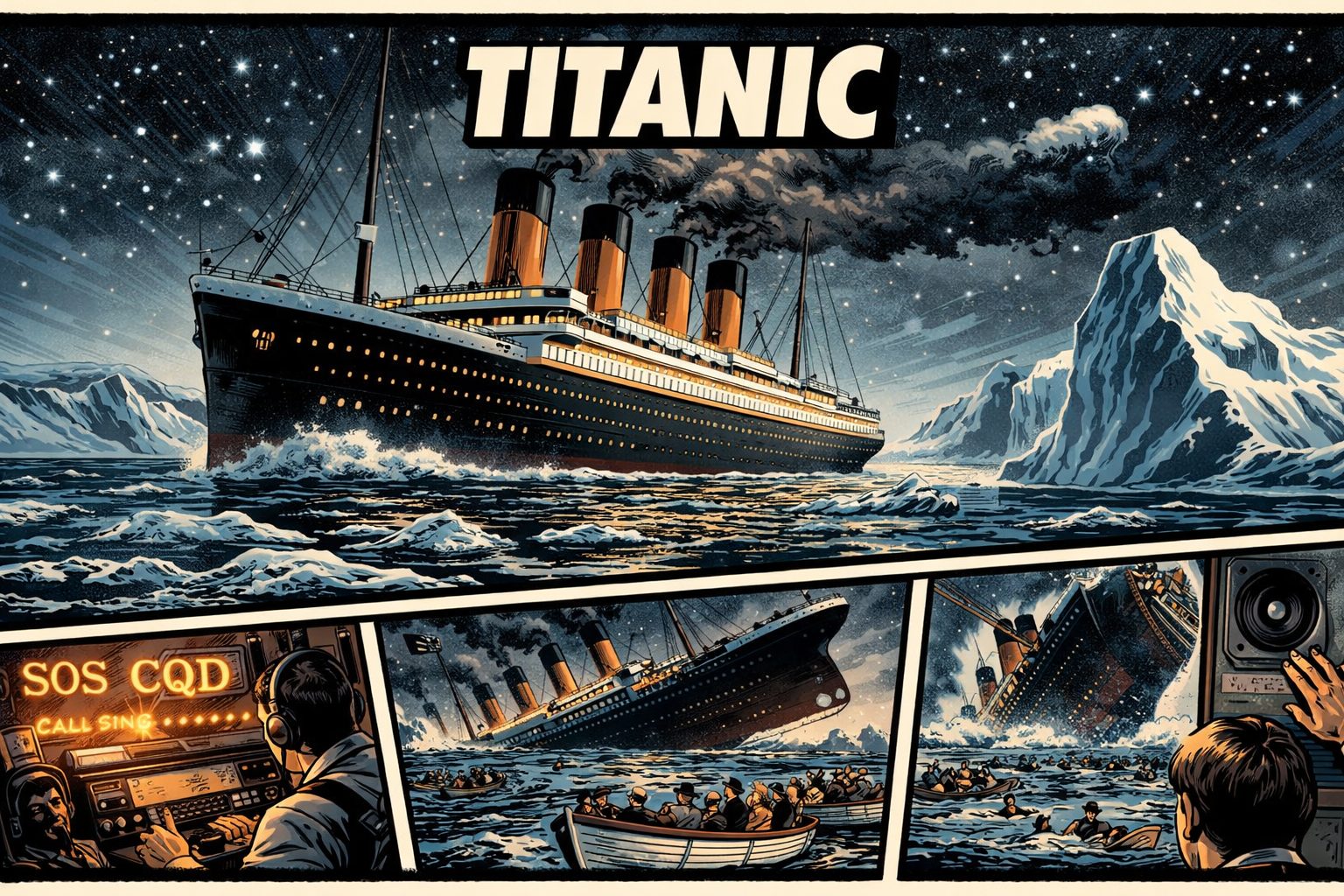

Few films have left as deep a mark on popular culture as Titanic. Directed by James Cameron and released in 1997, it became a global phenomenon almost immediately. For many viewers, it is remembered as a love story set against one of the most famous disasters in modern history. But the reason Titanic still endures is more complex. It is not only a spectacle about a sinking ship. It is a film about class, desire, memory, and the fragile illusion that human beings can control fate.
A love story inside a historical catastrophe
At the center of the film are Jack Dawson and Rose DeWitt Bukater, played by Leonardo DiCaprio and Kate Winslet. Their romance begins aboard the RMS Titanic, a ship presented as the greatest symbol of luxury, progress, and confidence. Rose comes from the world of wealth, social expectation, and suffocating control. Jack, by contrast, enters her life as an outsider — poor, spontaneous, and emotionally free. Their relationship is built on contrast, but it is also built on recognition. Each sees in the other a life that feels missing from their own.
This romantic storyline is one reason the film became so widely beloved. Cameron understands how to make emotion feel immediate even within a massive production. Jack and Rose are not written as abstract symbols. They are vivid, restless, and vulnerable. Their connection gives the film its emotional center and makes the later tragedy more devastating.
Class, power, and the illusion of order
What gives Titanic more weight than a simple romance is its attention to class. The ship is not just a setting; it is a floating social structure. The difference between first class and third class is visible in every room, every meal, every corridor, and every gesture. Cameron uses the ship to show how power organizes space itself. Luxury, freedom, dignity, and even safety are distributed unequally.
When disaster strikes, those divisions do not disappear. In some ways, they become even clearer. The film suggests that catastrophe does not erase social hierarchy — it exposes it. Panic reveals who is protected, who is delayed, and who is treated as expendable. In that sense, Titanic is not only a film about a shipwreck. It is also about the moral failure of a world that mistakes status for value.
Spectacle with emotional precision
One of the film’s greatest achievements is the balance it finds between technical scale and emotional intimacy. Cameron stages the sinking with extraordinary precision. The breaking ship, the flooding corridors, the tilt of the deck, and the sheer physical terror of the event remain deeply impressive even decades later. Yet the film never becomes empty spectacle. The disaster works because it is anchored in people: frightened families, separated lovers, musicians continuing to play, passengers trying to preserve dignity in impossible circumstances.
James Horner’s score plays a major role in shaping this emotional effect. The music gives the film grandeur, but also sadness and tenderness. It helps transform historical reconstruction into something elegiac. The film is interested not only in how the Titanic sank, but in what people felt as the world they trusted disappeared beneath them.
Why the film still matters
More than twenty-five years after its release, Titanic remains one of the defining blockbusters of modern cinema. Its popularity was never only about visual scale or romantic tragedy. The film continues to resonate because it combines intimacy with enormity. It tells a personal story while also confronting death, memory, and historical myth.
That is why Titanic still feels alive. It captures the arrogance of an age that believed technology could master nature, but it also preserves something softer and more human: the desperate need to love, to be seen, and to hold on to meaning when everything else is collapsing. Beneath the spectacle, Titanic is ultimately a film about what remains when certainty sinks — and only emotion survives.