
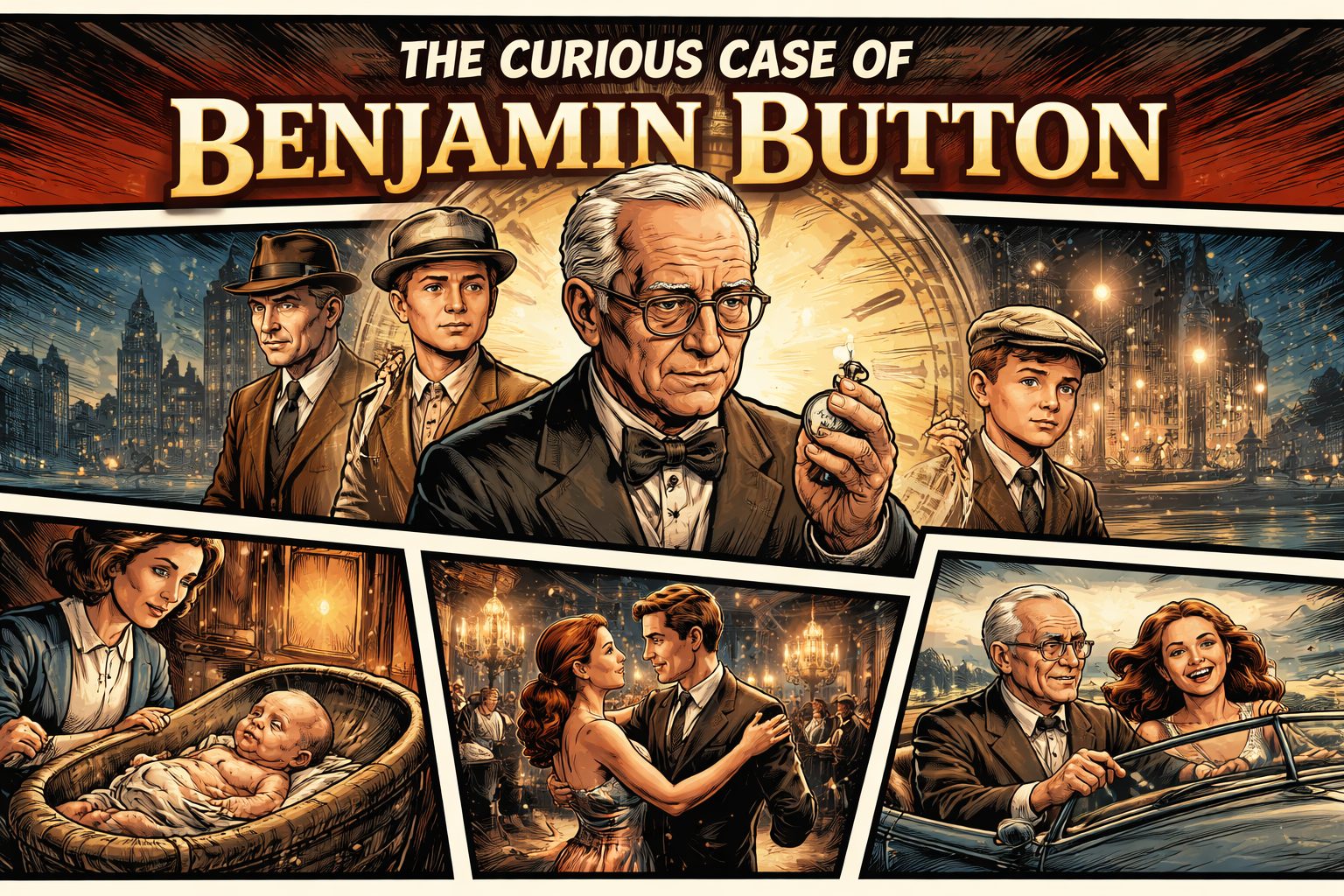

Few films approach the subject of time with as much tenderness as The Curious Case of Benjamin Button. Directed by David Fincher and released in 2008, the film begins with a fantastical premise: a man is born physically old and grows younger as the years pass. Yet what makes the film memorable is not simply the strangeness of that idea. It is the emotional truth the story finds inside it. Beneath its unusual concept, the film becomes a meditation on love, aging, memory, separation, and the painful impossibility of living in step with the people we care about.
A life told against ordinary logic
Benjamin Button, played by Brad Pitt, enters the world as an infant with the body of an old man. From the beginning, his existence defies normal order. Instead of moving from youth to age, he travels in reverse, becoming physically younger while time continues forward around him. This reversal gives the film its central emotional tension. Benjamin does not simply live differently from everyone else — he experiences the same world on a completely different clock.
The film treats this premise not as a puzzle to be solved, but as a condition to be felt. Benjamin’s life is filled with departures that arrive before beginnings, connections that cannot last, and moments of intimacy constantly threatened by time. The structure of the story reminds the viewer that even in ordinary life, love is shaped by timing. In Benjamin’s case, timing becomes destiny.
Love, distance, and the tragedy of mismatch
At the heart of the film is Benjamin’s relationship with Daisy, played by Cate Blanchett. Their bond stretches across years, chance encounters, absences, and reunions. What makes their romance so moving is that it is built not on permanence, but on misalignment. For much of the story, they are emotionally close yet physically out of sync. One is becoming older while the other becomes younger. Their love exists, but it cannot settle into ordinary life without conflict.
This idea gives the film much of its sadness. The Curious Case of Benjamin Button is not interested in love as simple fulfillment. It is interested in the way love can be real, deep, and transformative while still remaining temporary. The film understands that feeling can be powerful without being permanent, and that some relationships matter precisely because they cannot be kept forever.
Beauty, atmosphere, and quiet emotion
David Fincher directs the film with restraint and elegance. Although the story contains visually ambitious elements, the tone remains intimate and reflective. The imagery often feels soft, nostalgic, and touched by melancholy. New Orleans, changing through the decades, becomes more than a setting; it becomes a place where memory lingers and life seems always on the edge of disappearance.
Brad Pitt gives Benjamin a calm, searching quality that fits the character’s unusual condition. Cate Blanchett brings warmth, grace, and emotional clarity to Daisy, making her more than the object of Benjamin’s longing. Together, they create a relationship that feels fragile and lived-in rather than idealized. Alexandre Desplat’s score deepens that effect, giving the film a gentle sadness that never overwhelms the story.
Why the film still resonates
More than fifteen years after its release, The Curious Case of Benjamin Button remains one of the most emotionally unusual studio films of its era. Its central image is fantastical, but its meaning is deeply human. It speaks to anyone who has felt out of step with life — too early for one thing, too late for another, unable to hold still while the world changes shape.
That is why the film endures. It is not really about a man aging backward. It is about the universal sorrow of time itself: the fact that people meet, love, change, and lose one another under conditions they never chose. In turning life backward, the film reveals something painfully true about how life normally moves. We are all carried forward, whether we are ready or not, and what matters most is not control, but the fleeting beauty of what we are allowed to share.