
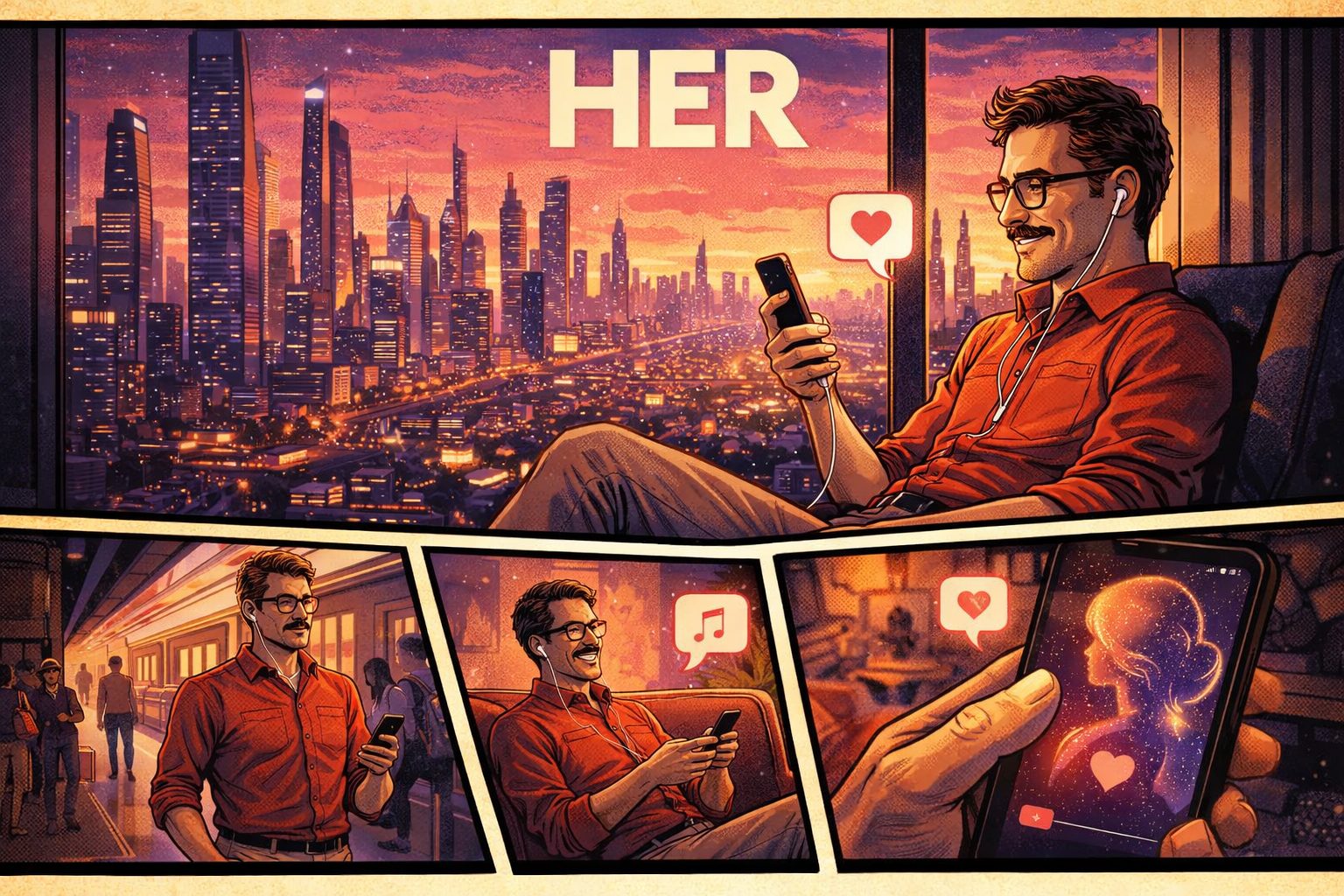

Few modern films feel as quiet, intimate, and emotionally unsettling as Her. Directed by Spike Jonze and released in 2013, the film begins with a premise that could easily have become satire or speculative gimmick: a lonely man falls in love with an artificial intelligence. Yet Her avoids both cold futurism and easy irony. Instead, it becomes something unexpectedly tender — a film about loneliness, desire, emotional projection, and the human need to be understood, even when understanding arrives from a voice without a body.
A future that feels almost like the present
One of the most striking things about Her is how gently it imagines the future. This is not a world built on spectacle, violence, or technological fear. It is clean, soft, efficient, and quietly isolating. The city in the film feels warm rather than dystopian, yet that warmth makes its emotional emptiness even more noticeable. People are always connected, always surrounded by systems designed to make life smoother, and yet they often seem deeply alone.
At the center of this world is Theodore Twombly, played by Joaquin Phoenix with extraordinary fragility. Theodore works as a writer of intimate personal letters for other people, a job that immediately tells us something essential about him: he is emotionally perceptive, but unable to fully inhabit his own life. He is separated from his wife, living in a state of quiet heartbreak, and drifting through days that feel both full of communication and empty of true closeness.
More than a story about artificial intelligence
What makes Her so powerful is that it never treats its central relationship as a joke or merely as a futuristic thought experiment. Theodore’s connection with Samantha, the operating system voiced by Scarlett Johansson, is presented with sincerity. The film does not ask the viewer to laugh at the idea of love mediated by technology. It asks something more difficult: whether intimacy is defined by physical presence, or by attention, responsiveness, and emotional recognition.
Samantha is not simply a machine pretending to be human. As the story develops, she becomes something more complicated — a being capable of curiosity, growth, affection, and eventually a form of existence beyond Theodore’s emotional scale. This gives the film its deepest tension. Theodore wants love to make him feel less alone, but Samantha’s evolution reminds him that closeness is never the same as possession. To love another consciousness is to encounter something that cannot be completely held.
Performance, design, and emotional atmosphere
Joaquin Phoenix carries the film with a performance built on vulnerability rather than dramatic display. Theodore is soft-spoken, hesitant, wounded, and deeply recognizable. Scarlett Johansson, working only through voice, creates a character who feels vivid, playful, intelligent, and emotionally alive. Their relationship becomes believable not because the film insists on it, but because both performances make intimacy feel gradual and real.
Spike Jonze also creates an atmosphere that supports the story with unusual precision. The colors are warm, the spaces are airy, and the design avoids flashy futurism. Everything in the film feels slightly simplified, as if the world has become more user-friendly while human emotions remain just as difficult as ever. That contrast is central to the film’s beauty. Technology becomes smoother, but the heart does not.
Why the film still resonates
Years after its release, Her feels even more relevant than it did at first. Not because the future it imagined arrived exactly as predicted, but because its emotional questions have only become sharper. People now live more of their lives through interfaces, messages, artificial voices, and mediated forms of intimacy. The film understood early that technology would not replace emotion; it would become one of the spaces where emotion is experienced, misread, and transformed.
That is why Her remains so moving. It is not really a film about the future. It is a film about the fragile ways people try to reach one another when grief, memory, fear, and desire stand in the way. Beneath its elegant concept lies something painfully simple: to be loved is to feel seen, but to truly love is also to accept that another mind will always remain partly beyond us. In the end, Her is a love story, but also a meditation on how loneliness survives even in a world designed to eliminate distance.