
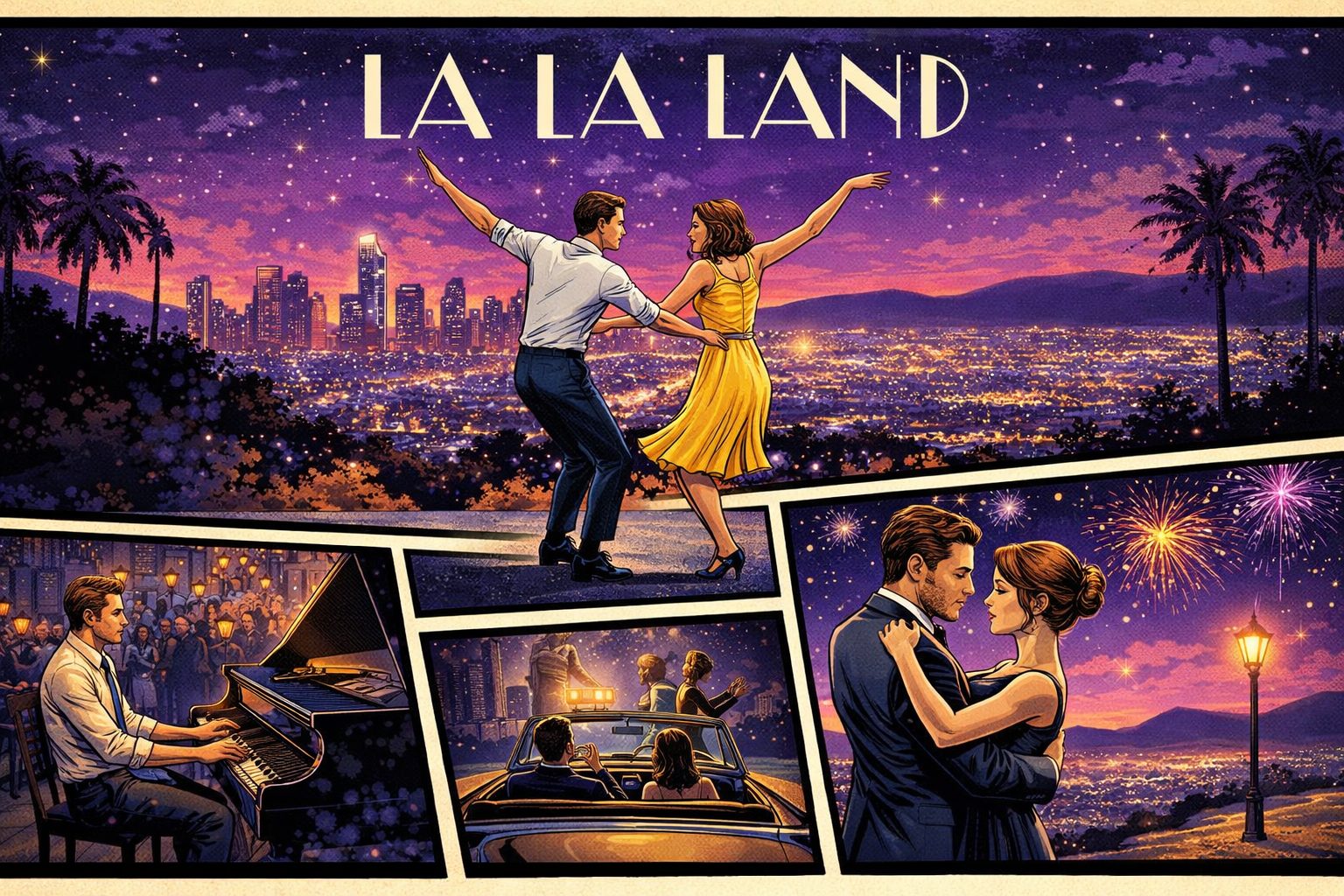

Few modern films feel as light on the surface and as bittersweet underneath as La La Land. Directed by Damien Chazelle and released in 2016, the film appears at first to be a bright and elegant tribute to classic Hollywood musicals. It is full of color, movement, music, and cinematic charm. Yet beneath that beauty lies something more delicate and more painful: a story about ambition, timing, compromise, and the difficult truth that love and success do not always grow in the same direction.
A city built on hope and illusion
Set in Los Angeles, La La Land follows two aspiring artists trying to build meaningful lives in a city that sells dreams to everyone and fulfills them only for a few. Mia, played by Emma Stone, is an actress struggling through auditions, rejection, and uncertainty. Sebastian, played by Ryan Gosling, is a jazz pianist devoted to a vision of artistic purity that feels increasingly out of place in the modern world. Their meeting gives the film its romantic energy, but their ambitions give it its emotional tension.
Los Angeles is more than just a setting here. It becomes a symbol of longing itself — a place where possibility feels endlessly close and endlessly deferred. The city glows, but it also exhausts. It invites fantasy while quietly demanding sacrifice. This gives the film its emotional texture from the very beginning. La La Land is not simply about chasing dreams. It is about what those dreams ask in return.
More than nostalgia
One of the film’s great achievements is that it uses the language of old musicals without becoming trapped in nostalgia. Chazelle clearly loves the tradition of Hollywood song-and-dance cinema, and La La Land is filled with visual references to that history. But the film never feels like a museum piece. Instead, it uses that familiar style to tell a very contemporary story about work, identity, and emotional compromise.
The songs are not simply decorative interruptions. They express states of hope, frustration, attraction, and imagination that ordinary dialogue could not carry as fully. At the same time, the film understands that music cannot protect its characters from disappointment. The beauty of performance coexists with the difficulty of real life. That contrast is what gives the film its special force. It invites the audience into fantasy, then gently reminds them that adulthood has its own demands.
Two performances built on fragility
Emma Stone gives the film its emotional soul. Her Mia is funny, intelligent, vulnerable, and quietly determined. She is not written as an abstract dreamer, but as someone whose ambition is constantly tested by humiliation and doubt. Ryan Gosling plays Sebastian with equal charm, but also with a stubbornness that makes the character feel both romantic and limited. Together, they create a relationship that feels sincere not because it is perfect, but because it is shaped by hesitation, compromise, misunderstanding, and genuine tenderness.
That is why the romance in La La Land works so deeply. The film never treats love as a magical solution to life’s uncertainties. Instead, it asks whether two people can fully remain themselves while trying to build a future together. That question gives the story its sadness. Sometimes love is real and still not enough to overcome the structure of two different lives.
Why the film still resonates
Years after its release, La La Land continues to hold a special place in modern cinema because it understands something difficult and universal. It understands that growing into the person you want to become may require losing the version of life you once imagined. That does not make the journey meaningless. In some ways, it makes it more human.
That is why the film stays with people. It is visually radiant, musically graceful, and emotionally accessible, but its real strength lies in its honesty. La La Land believes in beauty, but it does not confuse beauty with permanence. It knows that some of the most important relationships in life are not the ones that last forever, but the ones that shape who we become. In the end, the film is not only about dreams coming true. It is about the quiet ache of discovering what those dreams cost.