
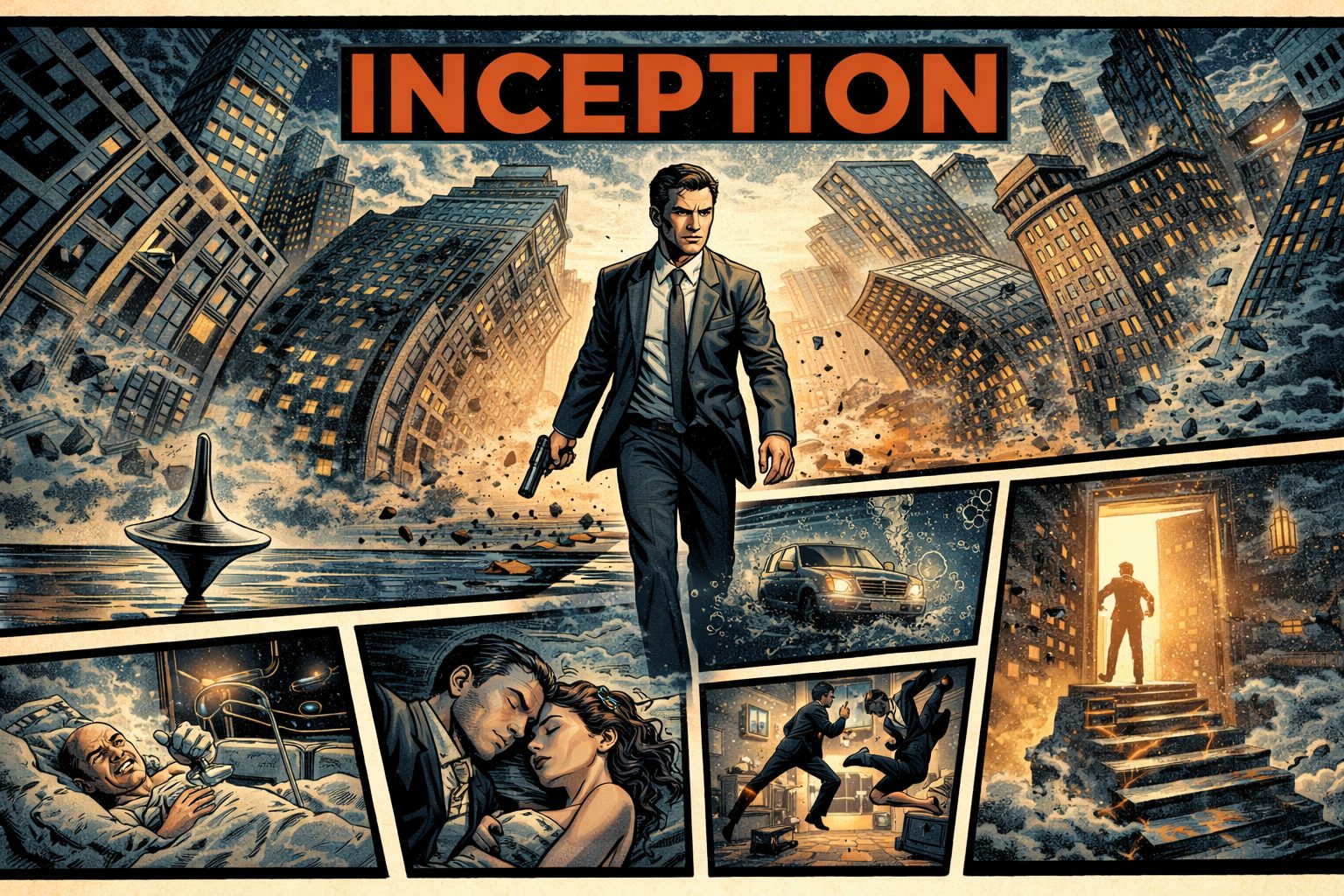



Christopher Nolan’s _Inception_ remains one of the defining blockbusters of modern cinema because it does something very rare: it delivers intellectual ambition, emotional weight, and large-scale entertainment at the same time. Many films offer spectacle, and many films offer ideas, but few combine both with such confidence. Even years after its release, _Inception_ still feels like a film that respects the audience’s intelligence without sacrificing momentum.

I would argue that _Inception_ is more impressive in construction than in feeling. It is undeniably ambitious, and its layered dream structure is clever, but cleverness alone does not make a film emotionally profound. For all its complexity, the movie often feels mechanical. The characters are mostly there to serve the concept, and the concept is always more vivid than the people inside it.
That criticism is common, but I think it underestimates what Nolan is doing. The emotional center of the film is not hidden at all. Cobb is not just moving through dream levels like a strategist in a puzzle. He is a man trapped by grief, guilt, and memory. The entire architecture of the story reflects that condition. The dreams are not only a visual invention; they are extensions of psychological damage.
The problem is that the film tells us that Cobb is suffering more often than it truly makes us feel it. His pain is important to the plot, but it does not always become fully lived emotion. Compared with the extraordinary precision of the mechanics, the emotional writing is less persuasive. Nolan can explain a system brilliantly, but he is sometimes less convincing when he tries to create intimacy within it.
And yet that tension is part of the film’s power. _Inception_ is a story about people trying to control unstable inner worlds. It makes sense that emotion appears through fragments, interruptions, and distortions. Mal is not written like a conventional tragic wife because she exists partly as memory, projection, fear, and desire. She is less a realistic character than the most dangerous expression of Cobb’s unresolved mind.
That may be conceptually interesting, but it also creates distance. Mal is memorable, yes, but often more as an idea than as a person. The same applies to much of the supporting cast. Arthur, Eames, Ariadne, Yusuf — they are effective in function, but they rarely become psychologically rich. The film gives everyone a role in the machine, but not always a full inner life beyond it.
I think that is partly intentional. _Inception_ works like a heist film, and heist films rely on precision, specialization, and movement. Nolan uses genre discipline to keep the story dynamic while building something stranger underneath. Ariadne guides the audience through the dream logic, Arthur provides control, Eames brings improvisation. Their clarity is a strength, not a weakness. Not every film needs every secondary character to become emotionally elaborate.
But when people call _Inception_ a masterpiece, the standards become higher. A masterpiece should not only function brilliantly; it should also leave behind a deeper human residue. I admire _Inception_ more than I love it. I remember the folding city, the hallway fight, the spinning top, the rules of the dream levels. I remember the design of the experience more than the human beings at its center.
I would say that is exactly why the film lasts. Its images are not empty. The folding city reflects instability. The collapsing dream worlds reflect mental pressure. The spinning top becomes unforgettable because it condenses the central anxiety of the entire film: whether reality can still be trusted once desire and memory begin shaping perception. Those visuals endure because they are tied to existential fear, not just style.
Still, one could argue that the ending is remembered partly because it avoids resolution rather than earning ambiguity. The final shot is brilliant as provocation, but it also allows the film to exit on a philosophical gesture that feels larger than the emotional journey itself. It is a powerful final image, yes, though perhaps also a calculated one.
Great cinema is often calculated. Precision is not the enemy of meaning. What matters is whether the calculation produces something alive, and in _Inception_ it does. The film captures a modern anxiety perfectly: the fear that our inner worlds may be stronger than reality, and that memory can become a place we would rather live in than the present. That is why the film remains more than a puzzle. It becomes a meditation on consciousness, loss, and the temptation of illusion.
I can accept that it is more than a puzzle, but I still think its reputation sometimes exceeds its emotional reach. _Inception_ is one of the most intelligent and influential blockbusters of its generation, but influence and brilliance are not always identical with depth. For me, it is a remarkable film to analyze, admire, and revisit — but not quite a film to surrender to completely.