
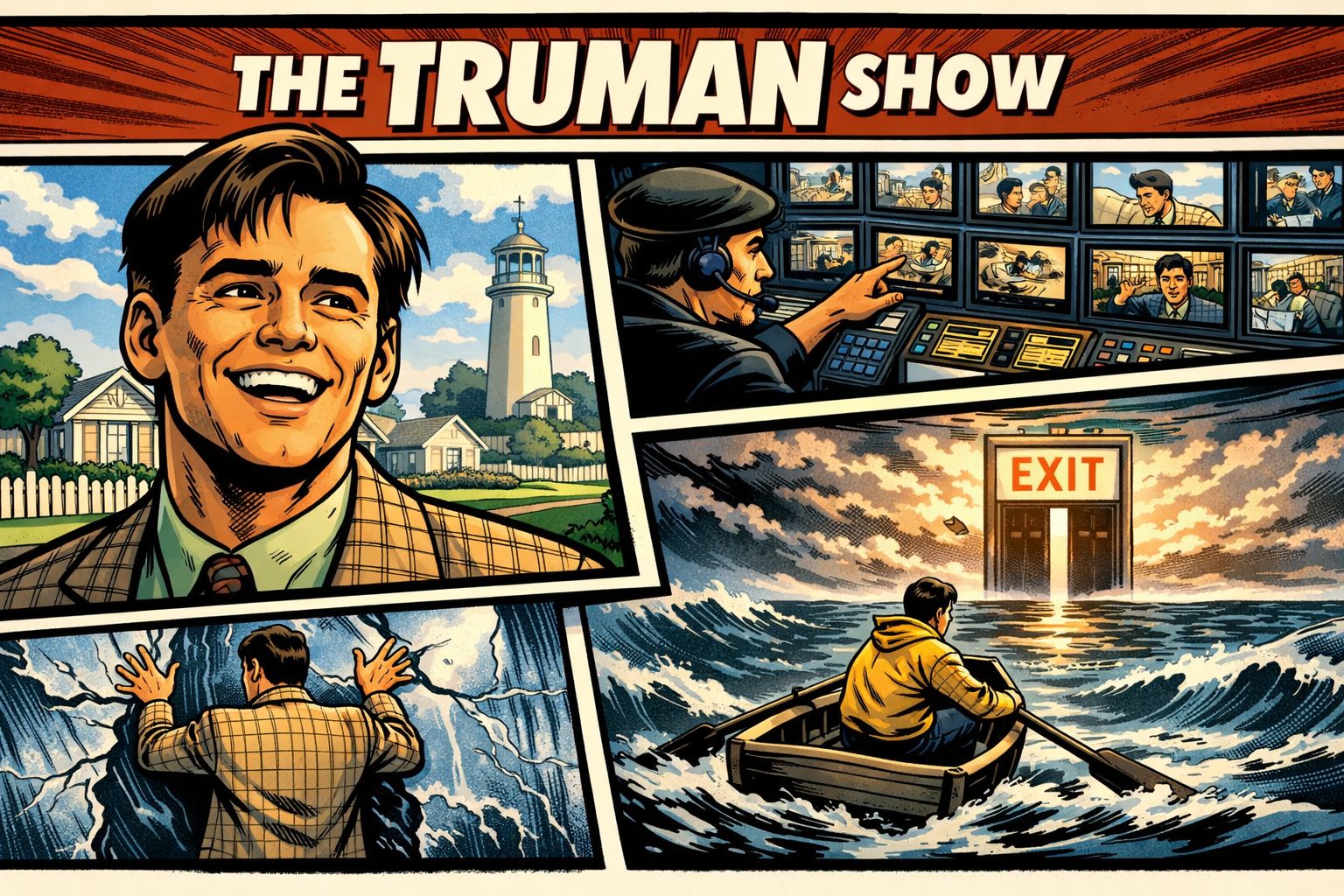

Some films become classics because of their performances, others because of their ideas. The Truman Show remains powerful because it succeeds in both. Released in 1998 and directed by Peter Weir, the film begins like a gentle satire and slowly transforms into something more unsettling, emotional, and philosophical. What first appears to be a clever story about television soon reveals itself as a reflection on freedom, control, truth, and the human need for a real life.
A simple life that feels too perfect
At the center of the film is Truman Burbank, played by Jim Carrey in one of the most surprising performances of his career. Truman lives in the peaceful town of Seahaven, where everything looks clean, friendly, and carefully arranged. He has a steady job, a cheerful wife, polite neighbors, and a daily routine that seems ordinary and safe. Yet from the beginning, there is something unnatural about his world. Small details do not fit. Strange accidents happen. Familiar faces appear in the wrong places. Reality begins to crack.
What Truman does not know is the film’s central premise: his entire life is a television show. Since birth, he has been watched by millions of viewers around the world. Every street, every conversation, every relationship has been designed for the audience. His town is a giant set. The people around him are actors. Even his fears have been carefully shaped to keep him from leaving.
Entertainment, manipulation, and control
What makes The Truman Show so effective is that it never treats its concept as a gimmick. It uses its unusual premise to ask difficult questions. How much of modern life is performance? How easily can comfort become a form of control? And how often do people accept false realities simply because they are easier than the truth?
The film is especially sharp in the way it presents media power. Truman is not trapped by bars or chains. He is trapped by storytelling, advertising, emotional conditioning, and the illusion of safety. The world around him is designed to feel pleasant enough that he will never seriously question it. That idea feels even more relevant today than it did at the time of the film’s release. In an age shaped by social media, surveillance, personal branding, and nonstop content, The Truman Show looks less like fantasy and more like prophecy.
Jim Carrey and the emotional heart of the film
Although the film is famous for its concept, its emotional force comes from Truman himself. Jim Carrey plays him with warmth, innocence, humor, and growing sadness. Truman is not a heroic revolutionary in the traditional sense. He is an ordinary man slowly realizing that his life has been stolen from him. That makes his journey more powerful. His search for truth is not abstract or intellectual — it is deeply personal.
Ed Harris, as the creator Christof, gives the film a calm and unsettling antagonist. He does not see himself as a villain. He believes he has protected Truman from pain, chaos, and disappointment. That is what makes him so disturbing. His control is wrapped in the language of care. The film understands that domination is often most dangerous when it presents itself as love, order, or protection.
Why it still resonates
More than twenty-five years after its release, The Truman Show still feels remarkably modern. Its themes have only become more visible: public identity, private manipulation, artificial intimacy, and the blurry line between reality and performance. Yet the film endures not only because it was ahead of its time. It endures because it believes in something simple and powerful — that even a comfortable illusion is worth less than an uncertain truth.
In the end, The Truman Show is not just about television. It is about the courage required to step beyond the world others have built for us. It is about choosing uncertainty over control, honesty over convenience, and freedom over spectacle. That is why its final image remains unforgettable. It is not simply an escape. It is the beginning of a real life.