
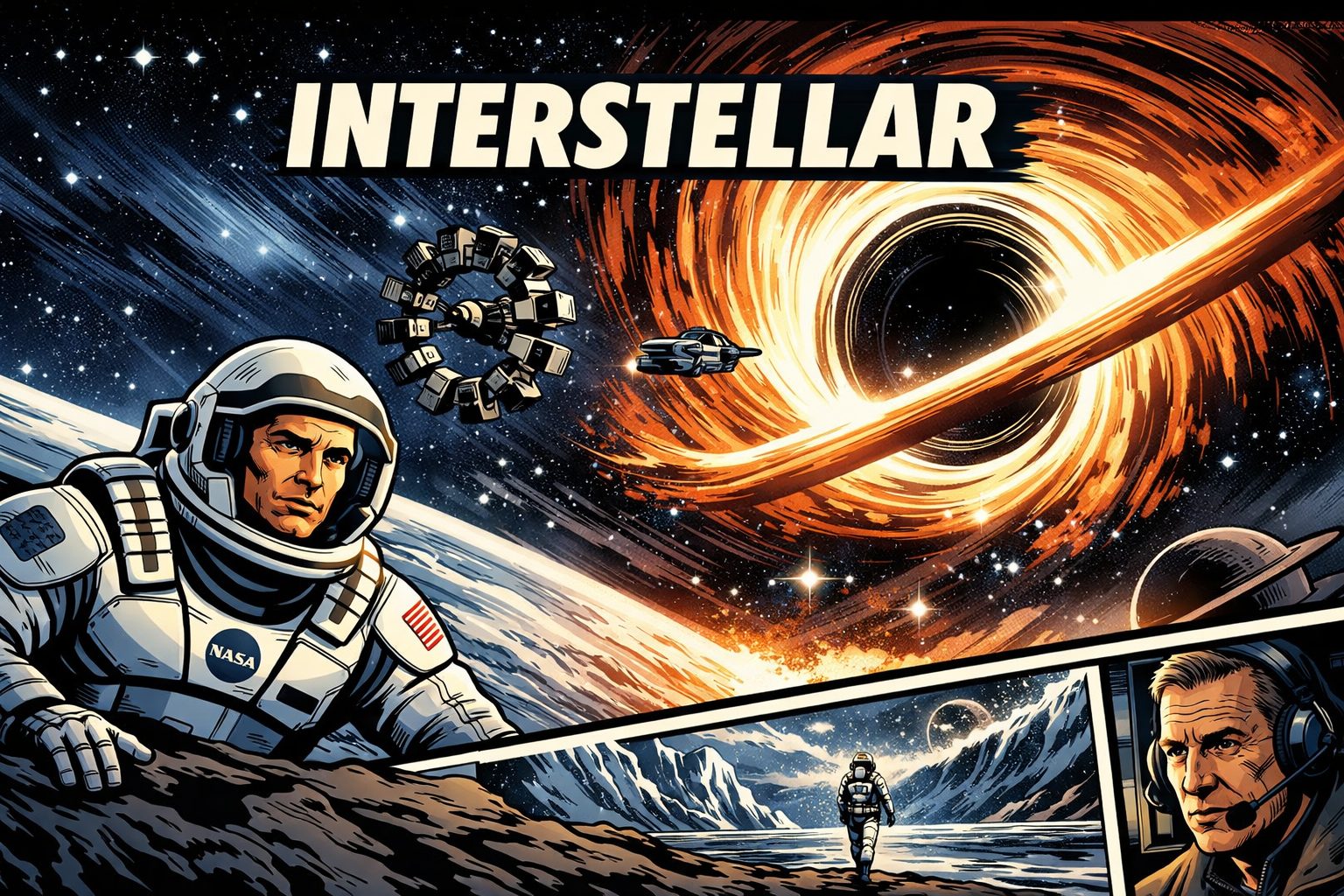

Few science-fiction films manage to be both spectacular and intimate, but Interstellar does exactly that. Christopher Nolan’s 2014 epic is a story about space travel, time, survival, and the future of humanity — yet at its core, it is also a story about love, loss, and the painful distance between people.
A future built on fear
The film takes place in a near future where Earth is slowly becoming uninhabitable. Dust storms sweep across the land, crops are failing, and society has lost much of its ambition. Instead of dreaming about the stars, people are focused on simple survival. This atmosphere gives Interstellar a rare emotional weight from the very beginning. It is not a distant fantasy about technology saving the world. It feels like a quiet warning.
At the center of the story is Cooper, a former pilot and engineer played by Matthew McConaughey. He is no longer exploring the skies; he is raising his children on a farm and trying to protect them in a dying world. When he is drawn into a secret NASA mission to search for a new home for humanity, the film opens into something much larger — but it never loses sight of the family he leaves behind.
More than a space adventure
What makes Interstellar memorable is that it refuses to be only one thing. It is a visually ambitious science-fiction film, full of wormholes, black holes, distant planets, and breathtaking cosmic imagery. At the same time, it is also a deeply emotional drama about a father and daughter separated not only by space, but by time itself.
The concept of time in the film is especially powerful. In many sci-fi movies, time is a puzzle or a clever device. Here, time becomes emotional reality. Minutes can become years. A single decision can cost a family an entire lifetime. Nolan uses complex scientific ideas, but the audience never needs to understand every equation to feel the impact. The heartbreak is immediate and human.
Performances, music, and atmosphere
Matthew McConaughey gives one of the most sincere performances of his career. His Cooper is intelligent and brave, but also fragile, guilty, and deeply human. The relationship between Cooper and his daughter Murph gives the film its emotional center, and Jessica Chastain brings strength and intensity to the older version of the character. Anne Hathaway, Michael Caine, and Mackenzie Foy also help create a cast that feels grounded even when the story reaches for the impossible.
Hans Zimmer’s score deserves special attention. Rather than relying on conventional sci-fi music, Zimmer created a sound that feels spiritual, massive, and haunting. The organ-driven soundtrack gives the film a sense of awe, but it also underlines its loneliness. In many scenes, the music does not simply support the image — it becomes part of the storytelling.
Why the film still matters
More than a decade after its release, Interstellar remains one of the most discussed science-fiction films of the 21st century. Part of that comes from its scale and ambition, but the real reason is simpler: the film believes that human emotion matters as much as scientific progress. It argues that survival is not enough on its own. People need meaning, memory, connection, and hope.
That is why Interstellar continues to resonate. It shows the end of one world while searching for the possibility of another. And in that journey through the unknown, it reminds us that the most powerful force may not be technology or physics, but the bonds we refuse to abandon.