
As rescuers in the northern Venezuelan port city of La Guaira dug through concrete rubble with their bare hands and families wept for the dead, acting President Delcy Rodríguez took to state television to address the catastrophic double earthquake that struck the country on June 24.
While the official death toll has surpassed 1,500, independent organizations and the United Nations estimate that tens of thousands more remain missing. Amid mounting public frustration over what many Venezuelans perceive as government inaction, Rodríguez sought to reassure the nation by laying out her administration’s disaster response plan.
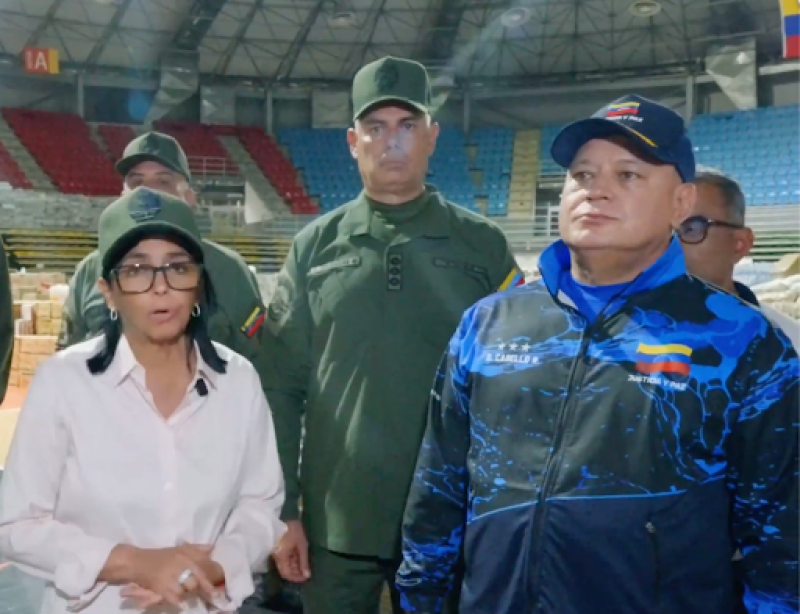
Yet, rather than standing alongside emergency workers on the front lines of one of the worst tragedies in Venezuela’s history, she was flanked inside a sports complex by the country’s most powerful officials—nearly all of whom are currently under severe Western sanctions for corruption, human rights abuses, and narcotics trafficking.
Wearing a military cap during the broadcast in the early hours of June 28, Rodríguez raised eyebrows by praising the Bolivarian National Armed Forces not for conducting perilous rescue operations, but for folding clothes and arranging food cans.
"So you can see how our Armed Forces are taking part in sorting clothing, clothes, medicines, food," Rodríguez said from the relief collection center at the José María Vargas Sports Complex, offering a jarring contrast to the grueling, bare-handed recovery efforts unfolding just miles away.
The optics of the broadcast underscored a stark political reality in post-Maduro Venezuela.
Since the capture of Nicolás Maduro and his wife, Cilia Flores, in January, Rodríguez has consolidated power by surrounding herself with a tight inner circle of blacklisted officials. Now, as the United Nations and independent organizations warn that tens of thousands remain missing following the disaster, Rodríguez has placed the country's entire humanitarian and reconstruction response into the hands of these very same sanctioned loyalists.
Standing directly beside her was Diosdado Cabello, the sectoral vice president for political sovereignty, whom the U.S. Treasury Department blacklisted in 2018 as the alleged head of a massive money-laundering and drug-trafficking network. Cabello, who still faces a $25 million U.S. bounty for his arrest, was instructed by the acting president to keep "working and inspecting" the clothing drives.
He is just one of at least six high-ranking officials currently leading Venezuela’s earthquake response who face international sanctions.
To manage the crisis, Rodríguez announced the creation of a "renewed Military Command" spearheaded by Defense Minister Gustavo González López, who has been sanctioned by the United States since 2015.
Furthermore, she tapped her brother, National Assembly President Jorge Rodríguez—himself sanctioned by both the U.S. and Canada for corruption and political repression—to head the presidential commission tasked with building temporary camps and planning rapid-housing projects for the displaced.
The broader reconstruction commission features Food Minister Carlos Leal Tellería, sanctioned by Canada; Caracas Mayor Carmen Meléndez, sanctioned by the U.S.; and Carabobo Governor Rafael Lacava, who was blacklisted by Washington in 2019 specifically for blocking the entry of international humanitarian aid into the country.
Rodríguez did not explain what safety standards these officials would apply to prevent future disasters, offering no technical strategy for how a government accused of systemic corruption would safely rebuild the hundreds of buildings that entirely collapsed.
The pervasive reliance on a blacklisted cabinet stands in sharp contrast to Rodríguez’s own status with Washington.
In a controversial move on April 1, the U.S. Treasury Department removed the acting president from its sanctions list as part of a diplomatic rapprochement aimed at easing restrictions on Venezuela’s oil and banking sectors. In the immediate aftermath of the earthquake, the U.S. Office of Foreign Assets Control even issued a temporary waiver suspending restrictions on financial transactions tied to humanitarian relief.
Yet, despite her recent delisting, Rodríguez remains a figure of intense scrutiny, with reports emerging in March that federal prosecutors in Miami had drafted an indictment against her for money laundering—a report the U.S. Justice Department publicly disputed.
Looking immaculately manicured and flanked by her elegantly dressed, sanctioned ministers, Rodríguez offered a message of sweeping optimism.
"While hope is in our hearts, there is always possibility," she said from her office, "and the future is always marked by joy." Miles away, beneath the mud and concrete, her citizens continued to search for their dead.
Source: Original article